
In Spain, Ug does not tell the whole story
Ug describes heat transfer through the glazing. With large south- or west-facing openings, solar heat gain must also be controlled. That is where the solar factor, or g-value, becomes important: the lower it is, the less total solar energy enters through the glass.
This is why we do not automatically specify one glass for every elevation. Glass area, orientation, overhangs, external shading and the architecture of the building should be considered together.
Guardian SunGuard SNX 60: when solar load is high
SunGuard SNX 60 is a highly selective triple-silver coated glass. In Guardian's published reference double glazing — 6 mm SNX 60 / 16 mm argon / 4 mm ExtraClear — visible light transmission is about 60%, solar factor g about 0.29 and Ug 1.0 W/m²K.
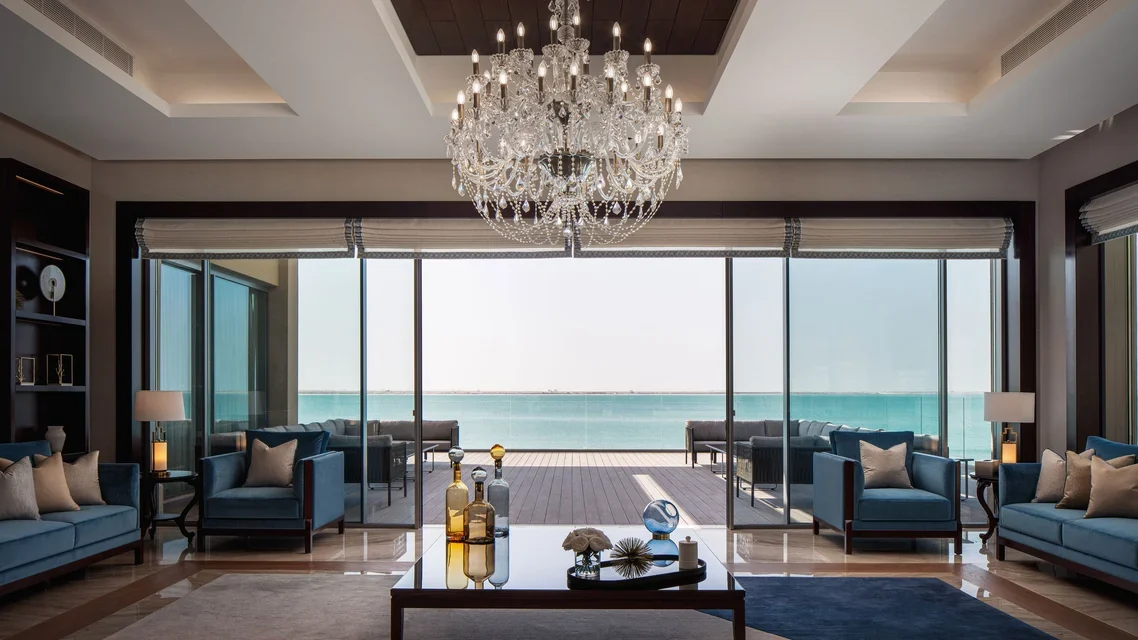
For us, that makes it particularly interesting for large panoramic openings, south- and west-facing glazing and projects where reducing summer solar gain is a priority without turning the façade into a dark reflective surface.
Large sliding doors, glazed façades and panoramic openings exposed to strong direct sun, especially where the sheer area of glass can become a major contributor to summer overheating.
Saint-Gobain PLANITHERM 4S: softer solar control with more daylight
PLANITHERM 4S is intended for window applications in hot climates in Southern Europe. For a 6 / 16 argon / 4 double-glazed unit with the coating on surface #2, Saint-Gobain publishes 65% light transmission, g 0.42 and Ug 1.0 W/m²K.
We see it as a balanced residential solution where generous natural light, low-e thermal insulation and moderate summer solar control are all important.
SNX 60 or PLANITHERM 4S?
| Guardian SNX 60* | PLANITHERM 4S** | |
|---|---|---|
| Visible light transmission | ≈60% | 65% |
| Solar factor g | ≈0.29 | 0.42 |
| Ug | 1.0 W/m²K | 1.0 W/m²K |
| Character | Stronger solar control | More daylight, softer solar control |
*Guardian reference: 6 SNX 60 / 16 Ar / 4 ExtraClear. **Saint-Gobain reference: DGU 6 / 16 Ar / 4. Values change with glazing make-up.
What we recommend for Spanish projects
For a very large panorama with strong south or west exposure, we normally start by studying a low-g solution such as SNX 60. For conventional windows or more moderate glazed areas, PLANITHERM 4S can offer an excellent balance of daylight, insulation and summer comfort.
This is not a ranking. Different elevations of the same house may reasonably require different glazing strategies.
The final IGU is selected after the dimensions are known
The coating name is only one part of the specification. Large panes require decisions about glass thickness, tempering or heat strengthening, lamination where required, cavity widths, spacer and safety. We then verify Ug, g-value and light transmission for the actual make-up.
FAQ
Which one gives stronger solar protection?
In the manufacturers' reference configurations, SNX 60 has a g-value around 0.29 compared with 0.42 for PLANITHERM 4S, so it admits considerably less solar energy.
Will SNX 60 make the interior too dark?
Guardian's reference configuration still transmits about 60% of visible light. For colour-sensitive architectural projects, we recommend evaluating a physical sample and the exact IGU make-up.
Can PLANITHERM 4S be used in large sliding doors?
Yes, but size and orientation matter. Saint-Gobain notes that large windows and sliding doors exposed to direct south or west sun may require a solar factor below 0.40. For those openings we check whether stronger solar control is appropriate.
Is Ug enough to choose glazing in Spain?
No. Ug, g-value, visible light transmission, orientation, glazed area and external shading should be assessed together.
Alba Ventanas · Valencia · Costa Blanca
We select the glazing for the façade, not just for the window.
Send us the dimensions, orientation and proposed system. We can study the IGU together with the aluminium window or sliding system.
Discuss your project ↗