
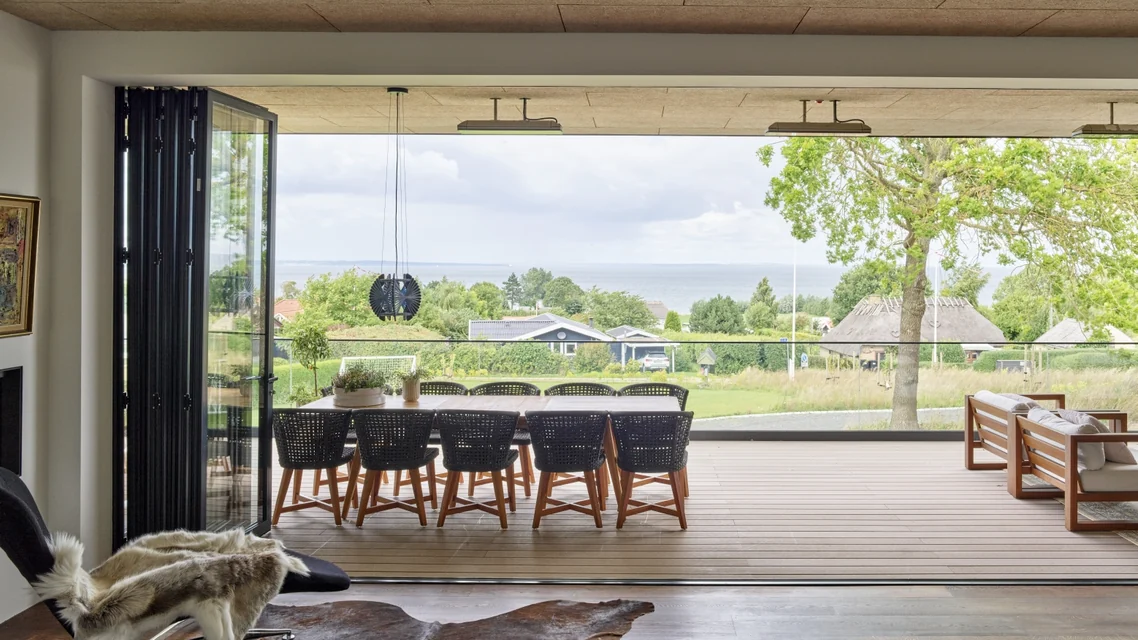
Large glass changes the thermal behaviour of a room
Panoramic glazing is one of the defining elements of contemporary villas in Spain. It also means that several square metres of façade can receive direct solar radiation for hours. On south and especially west-facing elevations, the glazing strategy has to be considered as part of the building envelope rather than as a finish selected at the end.
Ug tells us how much heat passes through the glass because of a temperature difference. It does not describe solar energy entering through the glass. For summer comfort, the solar factor — the g-value — is therefore just as important.
Step one: choose the glass according to the elevation
Two products we regularly study for Spanish projects are Guardian SunGuard SNX 60 and Saint-Gobain PLANITHERM 4S. In the manufacturers’ published reference double-glazing configurations, SNX 60 provides stronger solar control with a g-value around 0.29, while PLANITHERM 4S is a softer solution with more daylight and a g-value around 0.42.
That does not mean every large window should automatically use the lowest possible g-value. A protected north-facing opening and an unshaded west-facing sliding door are completely different design problems.
Read our full guide to SNX 60 and PLANITHERM 4S →
Step two: stop part of the sun before it reaches the glass
This is where exterior shading becomes especially effective. A ZIP screen is positioned outside the glazing, so the fabric can intercept direct solar radiation before it reaches the interior. Unlike an internal blind, it works on the exterior side of the façade.
On our Sun Shading page we use Aluprof Screen Systems as one of our exterior shading solutions. Aluprof’s current catalogue includes screen-system families such as SRS90, SRS90E, SRS90_SP, SRS/SKT and SRS/SKB. The correct system depends on the way the box and guides need to integrate with the window, façade and surrounding construction.
The screen can reduce direct solar exposure while preserving a degree of outward visibility. It also allows the glass itself to remain more neutral than if the entire overheating problem had to be solved only by making the glazing more selective.
Glass and ZIP screens should be specified together
For a large west-facing opening, we may begin with a strong solar-control glass such as SNX 60 and still provide an exterior screen because the peak afternoon sun can be intense. In another elevation, PLANITHERM 4S combined with a ZIP screen may provide a better balance between daylight, transparency and summer protection.
The key is not to treat glass and shading as competing products. They solve different parts of the same problem.
Aluprof ZIP screens need to be designed into the façade
The cleanest result is achieved when the screen box, guide rails, electrical supply and maintenance access are coordinated before the façade is finished. That is especially important with minimalist sliding systems, where a visible box added afterwards can undermine the architecture.
For new-build villas we therefore coordinate the screen position with the window or sliding frame, insulation, lintel, waterproofing and finished façade. Motorisation can then be linked to the house-control strategy, while wind exposure and safe operation are considered for each opening.
Architecture still matters: overhangs, orientation and terrace depth
A deep terrace canopy can protect high summer sun extremely well on some elevations. Vertical ZIP screens are particularly useful when the sun is lower, including afternoon exposure from the west. Trees, pergolas and external louvres can also contribute.
The best solution is often layered: architecture reduces the load first, exterior shading manages changing conditions, and the glass provides permanent solar control and thermal insulation.
What we would do on a Costa Blanca villa
We would start with the elevation drawings and identify the largest exposed openings. Then we would review orientation, glass area, terrace overhangs and room use. Only after that would we select the glass and decide where exterior Aluprof ZIP screens give a meaningful benefit.
For the most exposed panoramic openings, stronger solar-control glass such as SNX 60 is often the first candidate. For other elevations, PLANITHERM 4S may provide a more balanced result. The ZIP screen then gives the owner an adjustable layer of protection instead of forcing one fixed glass specification to solve every condition.
FAQ
Is solar-control glass enough by itself?
Sometimes, but not always. With very large exposed glazing, exterior shading can substantially improve comfort because it intercepts direct solar radiation outside the building.
Are ZIP screens suitable for large sliding doors?
They can be, provided the dimensions, wind exposure, box, guides and operation are selected for the specific opening. We coordinate the screen system with the sliding system rather than adding it afterwards.
Which Aluprof systems do you use?
Our sun-shading range includes Aluprof screen systems. Aluprof’s current screen catalogue includes SRS90, SRS90E and related system families; final selection is confirmed for each project.
Should every façade use the same glass?
No. Different orientations can justify different solar-control strategies, provided the external appearance and colour consistency are reviewed carefully.
Alba Ventanas · Valencia · Costa Blanca
Design the glass and the shade as one façade.
Send us the elevations, opening sizes and orientation. We can study the glazing and Aluprof exterior shading before the façade details are fixed.
Discuss your project ↗Technical references: Guardian Glass, Saint-Gobain Glass and the current Aluprof Screen Systems catalogue. Performance and dimensions depend on the final configuration.